

A while ago I started to look for a book about the lifelong effects that the early death of your mother can have, especially if you do not go on to have children. I wrote here about only really starting to grieve properly in my late thirties, and I wanted something that explained the way I had turned out.
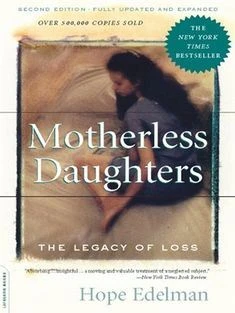
So I bought ‘Motherless Daughters: the Legacy of Loss’ by Hope Edelman.
The one thing I related to immediately in Edelman’s book was the way she describes the compulsion, in your teens and twenties, to let everyone know that your mother is dead – it is as much a defining element as where you come from, or what you do:
‘Meet you in the lobby in ten minutes- I have long brown hair, am on the short side, have on a red coat, and my mother died when I was nineteen.’
For Edelman, in those years, having a dead mother was definitely top of the list of elements that defined her as a person, and she would describe herself thus:
1. My mother died when I was seventeen. 2. I’m in graduate school in Iowa. 3. My boyfriend is XYZ.
At the end of the book, now in her forties, her list reads like this:
1. I’m a mother of two daughters. And a wife. 2. I’m a writer and a teacher. 3. I’m a New Yorker living in LA.
Of course it’s positive that having a dead mother no longer defines who Edelman is; it would not be top of my list, either. But I find it harder to say what is top of my list, these days, and I wanted this book to help me with that.
But Edelman can only really offer up babies as resolution for the strangeness of losing your mother early, concluding that most women ‘find renewal and the healing of childhood pain in the experience of bringing a child into the world’.
Women report that they ‘feel whole again’ when they have a child of their own, she says.
In examining her own healing process, Edelman places value on becoming a mother before all else; this is absolutely valid for her, but I get the impression that she can’t really relate to any other perspective other than her own. I gleaned nothing from the final chapters apart from a subtle:
go on, have children, it might help.
Edelman seems stumped on the topic of women who don’t or can’t have children: it’s barely mentioned.
Another overarching theme is that we idealise our dead mothers, honouring them ‘by granting them posthumous perfection’. The book continually returns to the trope of exalting the ‘flawless‘ dead mother. I could not relate to this either.
I tend to mostly remember the bad things.
She is very strong on fear of dying at the age your mother died (I could never see beyond the age of thirty-nine, myself), and on the hypochondria garnered from watching her die. The horror of the deathbed experience is presented devastatingly well. She’s good on how communication is paramount, and on the fallout when surviving family don’t talk about the dead mother.
The author clearly takes pains to include examples of (in her opinion) culturally diverse women; however, if you are not like Edelman – a mother and a wife – you might not find much in the way of real solace or healing in her books.
She went on to write Motherless Mothers, which I think rams my point home.
Do children really make women who lost their mums at a formative age ‘feel whole again’, I wonder? It sounds a bit simplistic, to me. And was there not just a bit more to say about women who don’t end up with children?
I think she needs to write another book, but I’m not sure it would catch on: Motherless Childless and Childfree Daughters (?)
Frustrating, I’m sure. Which is why I can imagine the compulsion to unpick your own thoughts through writing. You mentioned a sister in another post. I was wondering if you can relate to each other on these matters. That’s not to assume that siblings can; often the biggest gulf can be between them. I someone I’m just curious about your network. Feel free to ignore any questions. I understand you’re writing here on your terms.
LikeLiked by 1 person
I gather that there are hundreds of issues involved if you have kids and are largely parent-free: severe loneliness around the birth, with no input/fanfare from grandparents; pain of watching other kids/parents interacting with said grandparents; kids having fewer family members, less attention; listening to peers talking about their mothers etc: endless stuff. I know all that causes anguish. Apart from that I don’t know much. But you do come across this motif all the time, that a birth somehow makes a death ‘better’, so I suppose it might do in some ways. For me, unpicking the thoughts sometimes leads to: ‘Hmm I’m not as bothered about that as I thought I was’ so it must be good for something…
LikeLiked by 1 person
I get you. What is universal and what is not. And to what degree.
LikeLike
I think you should write the book .
LikeLiked by 1 person